Coral Gables · 7 min read
Landscape Design in Coral Gables: Creating a Garden Around the Architecture
Coral Gables is a place where architecture comes first. Its streets were planned with a clear idea of how houses, trees and public space should relate, and many of its homes sit within established neighborhoods and mature vegetation.
Designing a garden here is less about making a statement and more about responding to what already exists: the house, its proportions, the trees around it and the character of the street.
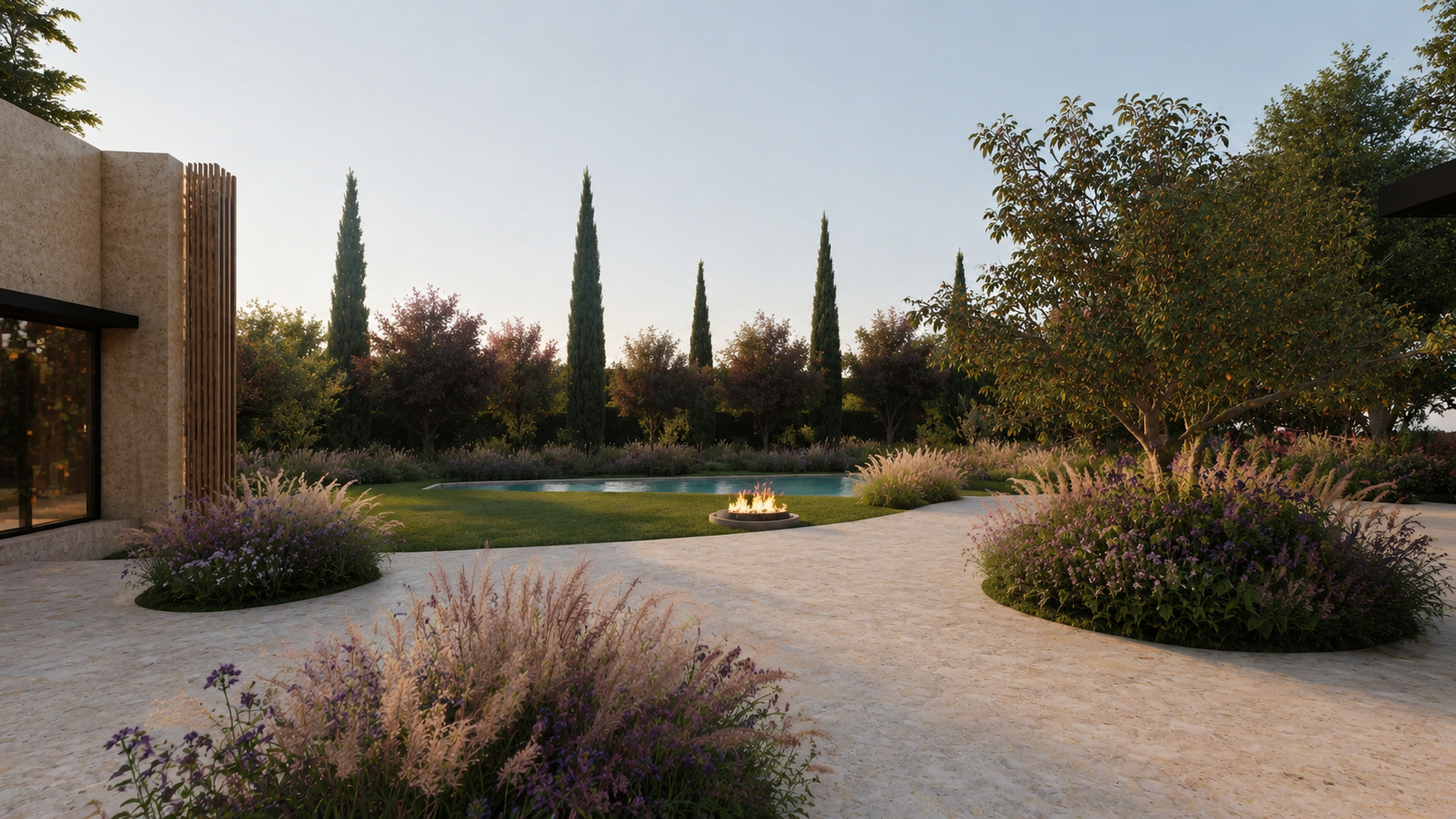
Nistal Landscape Design portfolio, Spain.
Read the house before designing the garden
Every good landscape in an architectural setting begins with the building. We study its proportions, axes, openings, materials and the rooms that look onto the garden.
Those lines become the starting point: a terrace aligned with a living room, a path continuing a hallway, a tree placed to close a view from a window. When the garden follows the logic of the house, the whole property feels composed rather than assembled.
Respect what is already established
Many properties in Coral Gables have trees that took decades to grow. Where they are healthy and well placed, preserving them is usually the most valuable design decision in the project. A new garden organized around a mature canopy feels settled from the first day.
Requirements relating to protected trees, permits and works on existing vegetation depend on each property and must be confirmed with the relevant local professionals and authorities. We treat this as part of the early coordination, not as a detail to resolve later.
The arrival sequence
The front garden is the first impression of a home and the part of the landscape most connected to the street. It should feel generous and calm, not busy.
Entrances that belong to the house
An entrance works best when paving, planting and lighting extend the architecture outward. The route from gate or driveway to the front door can be a small sequence — a change of material, a framed view, a moment of shade — rather than a straight line.
Boundaries and privacy
Walls, hedges and gates should be proportionate to the house and the street. Planting in front of or behind a boundary softens it, and layered vegetation often gives more privacy than height alone.
Courtyards and transitions
Courtyards, loggias and covered terraces are where interior and exterior meet. In a climate where outdoor living continues through most of the year, these transitions deserve the same care as the rooms inside.
We think about continuity of floor levels and materials, the quality of shade, and what is seen from inside. A single tree in a courtyard, or a quiet planted bed against a wall, can change how a whole wing of the house feels.
Pool gardens and outdoor living
The pool is often the largest single element in a garden, and its position affects everything around it. In an architectural setting it should relate to the house’s geometry and views, with terraces, shade and planting organized around it.
The considerations are similar across South Florida, and we cover them in depth in our guide to planning a pool and garden in Miami.
Structure rather than decoration
A garden that feels timeless usually relies on a small number of strong decisions: clear spaces, well-placed trees, consistent materials and planting massed with intention.
Planting softens architecture, but it does not need to compete with it. Restraint in materials and a limited plant palette allow the house to remain the protagonist while the garden gives it context and depth. Good planting also has to work in Miami’s tropical climate, so the choice is always both aesthetic and practical.
A European sensibility, interpreted for South Florida
Our studio is based in Madrid, and our work is shaped by Mediterranean gardens: their shade, their calm, their close relationship with architecture.
That sensibility can be meaningful in Coral Gables, but it should never be reproduced literally. Plants, materials and technical solutions have to respond to a subtropical climate. What travels is the approach — proportion, restraint, and the idea that a garden should feel as though it has always belonged to the house. You can read more about our work for Miami homes and how we collaborate with local architects, contractors and specialists.
Designing for the long term
The best gardens in established neighborhoods look better every year. That requires planning for growth, allowing space for trees to mature and defining a maintenance approach from the start.
Our aim in Coral Gables is simple: a landscape that respects the house and the street, and feels established rather than new.